
Your outdoor lighting doesn’t have to blind you
Traditional approaches to outdoor technology don't always work…
That’s particularly true when it comes to lighting.
The approaches we see most often involve burying a wire or two to bring electricity to a shed, or installing cold white floodlights that turn on when someone enters your driveway. They do the job, but they aren’t exactly offering much else.
Counterintuitively, when outdoor lighting is an afterthought at a property, these traditional solutions end up being all or nothing. Lights are on, or they're off. That's it.
Your single overhead bulb works to light the shed, but unless you blind yourself (and your neighbours) with your floodlights when it’s dark, you can’t see your way down to it.
The result of those floodlights turning on and off repeatedly is light pollution, excess power consumption, and wasted money. Your shed feels a bit dingy; and If you're hosting, garden lighting that turns night into day isn’t exactly brilliant for helping people relax.
Well considered outdoor lighting is designed around zones. We consider the three to five metre zone outside your home as an extension of your living space, so this is important to consider as the foundation for building the rest of your garden’s lighting zones.
Whilst we don’t consider ourselves lighting designers when it comes to indoor spaces, we do know a thing or two about how to design lighting plans for outdoor spaces. We even deliver a CPD to architects and interior designers that covers the fundamentals of outdoor lighting, amongst other outdoor technologies.
Good outdoor lighting designers recognise that each zone in your garden serves a different purpose - just like the zones in your house do. Smart lighting solutions for gardens work on the basis that individual lighting circuits are individually controlled to serve the intended use of each zone. As with smart lighting inside a home, lighting moods across these zones can be achieved at the touch of a button.
A good outdoor lighting designer recognises that (amongst other things):
- Paths are used for wayfinding
- The perimeter needs to be protected
- And the dining table needs atmosphere
How these areas are lit matters for getting the most out of an outdoor space - particularly if it's a new build and there's scope for ducting whilst landscaping is taking place.
If seeing the stars is important to you, dark skies lighting principles can be applied to your lighting design to reduce your lighting’s impact on the environment outside of your four hedges.
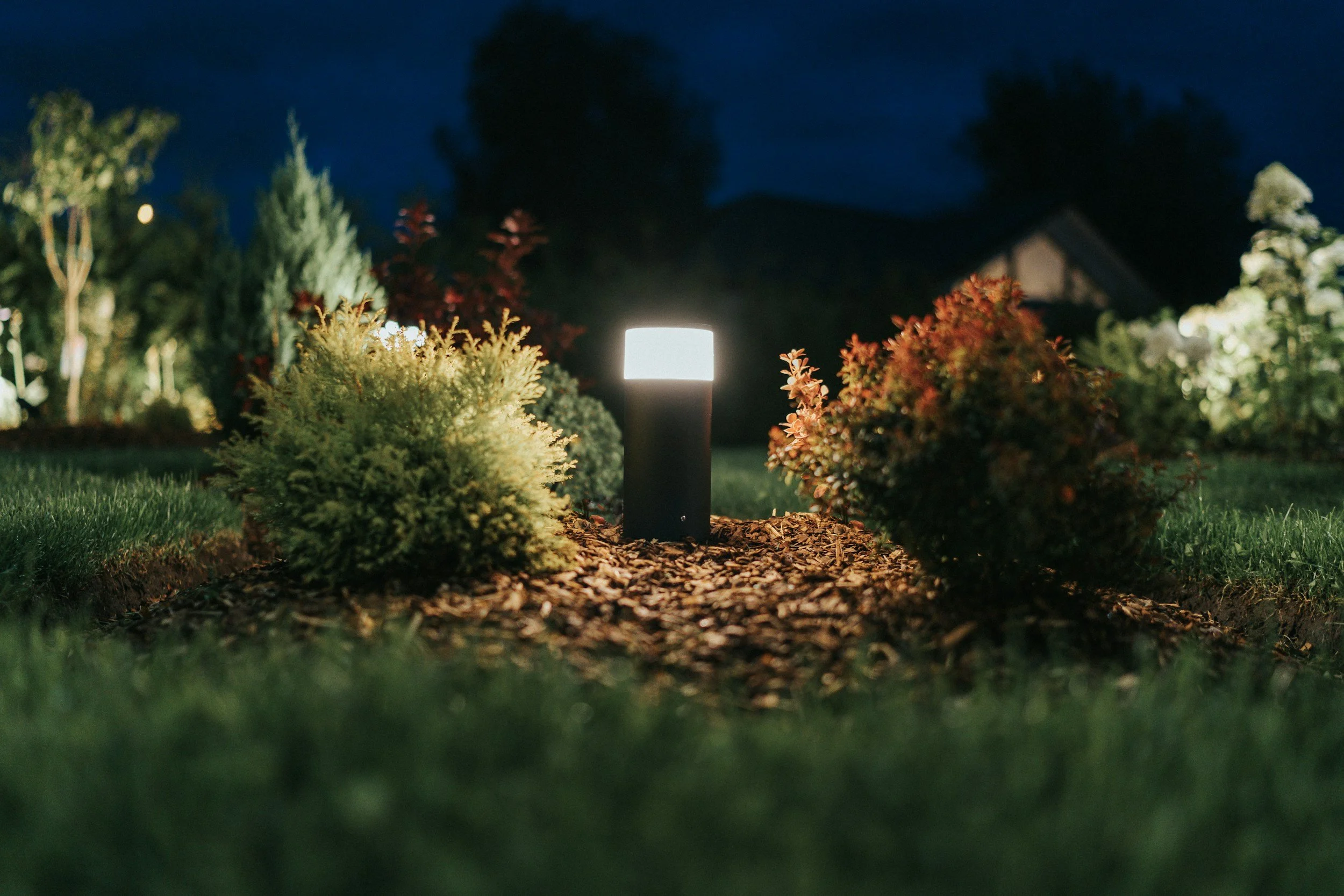
Pathway lighting has to help you see where you’re going. That’s a given. These can be bollards or spikes, with any steps transitioning to recessed lighting. There are options for all aesthetics, whether you want your lights hidden amongst greenery or as a feature of their own accord.
Floodlights can be appropriate for protecting the perimeter of your property. Pairing this motion sensored solution with a CCTV system that’s connected to the smart system inside your home allows you to see who's been where, and when. An intercom can also be connected at gates if there are legitimate reasons for why visitors might enter your home that way. We’ll consider colour temperature when we suggest floodlights - you don’t need to be blinded by 5000K.
For outdoor dining, the same principles for indoor dining are applied. You want to create a relaxed, intimate environment that still allows people to see if their burger is cooked. Warm whites are the go-to here, with layers of fixtures, fittings and tabletop solutions to draw the space together.
If outdoor lighting is currently an afterthought for you, we can help. We also offer outdoor audio, access control, and multimedia solutions to make indoor/outdoor living easy.
We do everything from the design to the installation of the tech for our projects, so if designing for outdoor living is new to you we can take care of every element. Our outdoor technology solutions consider if what we want to install is suitable for the environment it’s being installed in as a standard practice, making for safe, reliable systems that work for a long time.
You don’t have to have an existing smart system installed at your home to make a garden installation worthwhile. If you have sheltered space for us to put a panel either in a shed, garage, or inside your home then there’s no reason to wait.
If you do have a smart system installed, great! We can connect your home to your garden to help you live a more connected, simplified life.
Either way, we can have your outdoor lighting softened to suit dark skies and barbecues before the summer even starts.
To get started on your project, send us a message for more or share your plans at info@epitomeliving.com.